Quick-service restaurants (QSRs) used to win on a familiar formula: be fast, be convenient, and keep the price point appealing. Those things still matter, but the way customers engage with QSR brands has changed dramatically. Nearly 75% of all restaurant traffic now happens off-premises, nearly 6 in 10 Gen Z and millennial consumers use takeout or drive-thru at least weekly, and 57% of adults have recently used mobile ordering.
That creates more opportunity, but it also raises the bar for brand experience. When more of the journey happens through apps, drive-thrus, kiosks, and pickup, brands have fewer chances to recover from friction and more pressure to deliver value, relevance, and consistency in every interaction.
Consumers still want convenience. They still want speed. They still want those small “treat yourself” moments that make QSRs part of everyday life. But they are making sharper judgments about which brands feel worth it.
That is what makes brand experience so important for QSR brands. Customers are not simply deciding where to eat. They are deciding which brands deliver enough value, relevance, and consistency to earn another visit.
To understand what this means in practice, here are 5 trends we’re seeing in the quick-service restaurant space—and how experience management helps brands act on them.
1. Win on value, not price alone
The first trend shaping QSRs is the changing meaning of value.
In the past, value was often shorthand for price. Today, customers define it much more broadly. Among
QSR customers, the top motivators are taste (49%), speed (47%), convenience (45%), followed by affordability at 35%. A low price still matters, but only if the experience holds up. A premium offer can still work, but only if it feels justified.
Value now includes the full experience. Customers notice whether pricing feels fair, whether promotions are easy to understand, rewards actually feel rewarding, and the experience itself feels smooth and consistent.
2. Make QSR personalization feel useful, not generic
Personalization continues to be one of the biggest opportunities in the QSR industry, but it only works when it feels relevant.
Customers do not want more messages. They want interactions that make the experience easier. They want offers that reflect what they actually order, timing that makes sense in the context of their routine, and recommendations that feel grounded in real behavior.
That sounds straightforward, but too often, personalization feels generic, repetitive, or disconnected from the moment. A recommendation that arrives at the wrong time or a discount tied to an irrelevant product does not strengthen the experience. It creates noise.
Personalization is one of the clearest ways a QSR brand can show customers it understands them. When it works, it reduces effort and increases confidence. When it does not, the experience feels devalued.
3. Use AI to reduce friction and make faster decisions
AI is no longer just a future-state conversation for QSRs. It is quickly becoming part of everyday operations and experience design.
Brands are not just using more AI. They are expecting it to play a bigger role in how work gets done. That means moving beyond analysis to help teams move faster, identify what matters, and make better decisions across marketing, operations, and frontline execution.
That can mean identifying friction in the ordering journey, spotting demand shifts faster, surfacing which offers are resonating, or highlighting the moments most likely to affect loyalty. The real value is not in creating more reports. It is in reducing the time between insight and action.
That is what makes AI important to brand experience. It helps teams stay closer to what customers are actually experiencing and respond while it still matters. In a category where habits shift quickly and switching brands is easy, speed is strategic.
4. Improve self-service channels without losing the human side of the experience
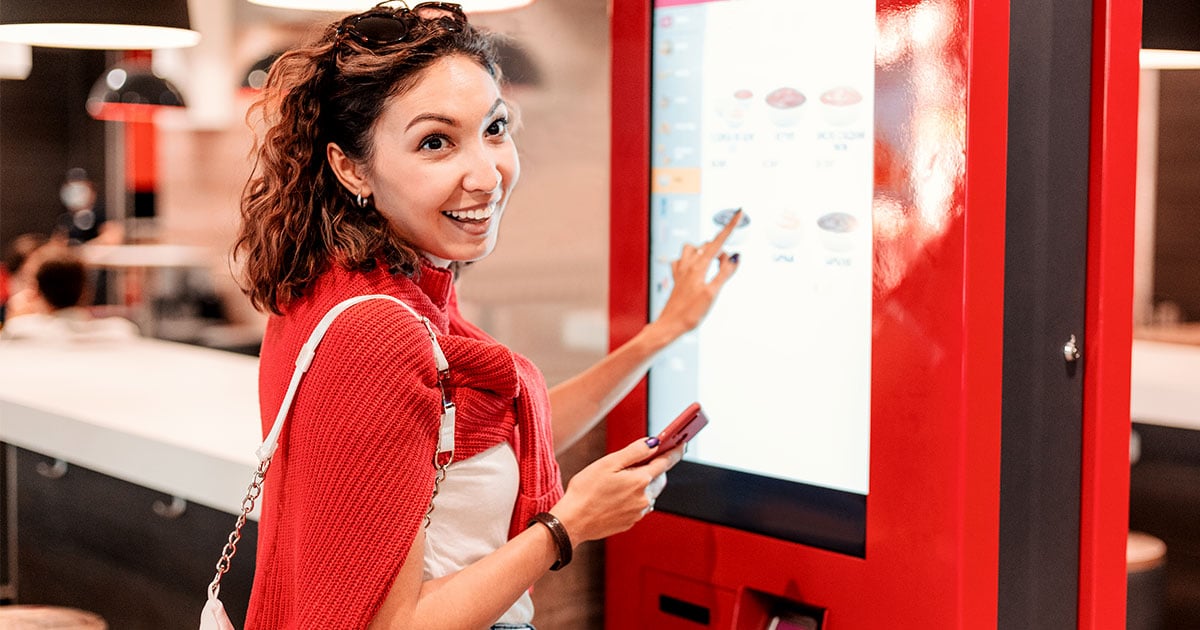
Self-service is now a core part of QSR customer experience. Apps, kiosks, digital ordering, and delivery integrations are no longer differentiators—they are expected.
Eighty percent of consumers believe good technology is important when choosing a QSR. Also, more than 60% of customers use self-service kiosks at least occasionally and 26% of customers use them frequently.
What customers care about now is how easy those channels feel.
If self-service adds friction, it works against the very convenience it is supposed to create. Confusing interfaces, unclear pricing, difficult customization, or a frustrating loyalty redemption process can turn a fast interaction into a frustrating one. Customers do not separate those moments from the brand. They treat them as the brand.
At the same time, more digital does not mean less need for human connection. In fact, it often raises the bar for it. When a digital touchpoint fails, employees absorb the frustration. When self-service creates confusion, employees are the ones expected to restore clarity.
Pro tip: The strongest QSR brands are making self-service more effortless while giving frontline teams what they need to step in confidently when the moment calls for it.
5. Build loyalty through consistency, clarity, and emotional payoff
Loyalty in QSR does not come from points alone.
Customers stay loyal when the value is obvious, the experience is consistent, and the brand gives them a reason to come back beyond convenience. That might be a genuinely useful
loyalty reward, a personalized offer that lands at the right time, or simply the confidence that the experience will feel familiar and easy no matter how they engage.
This is where many brands still struggle. A loyalty program may look strong on paper but feel underwhelming in practice. A campaign may promise one thing while the in-store or app experience delivers another. A brand may have a strong product but inconsistent execution across channels.
These gaps matter because loyalty is built in repetition. Customers come back when the experience repeatedly confirms that the brand is worth it. In the QSR world, consistency is what turns a transaction into a habit.
How experience management helps QSR brands act on these trends
All of these shifts point to the same challenge: QSR brands do not just need more data. They need a clearer way to understand what customers value, where friction is showing up, and how brand experience is actually landing across every channel.
UXM helps connect signals that often sit in silos. It brings together customer feedback, employee input, and operational performance so teams can see not just what is happening, but why. That matters in QSRs because the customer journey moves fast, expectations are high, and small experience breakdowns can have an outsized impact on loyalty and brand perception.
When QSR brands use UXM well, they can:
- Identify where perceived value is falling short
- Spot friction in self-service, loyalty, or service interactions
- Understand how frontline realities affect customer experience
- Adjust faster before small issues become bigger trust problems
The advantage is the ability to turn that insight into better decisions while the experience is still happening.
How Ignite® from SMG helps QSR brands deliver better brand experience
Ignite® from SMG helps QSR brands connect customer, employee, and operational insight into a single actionable view, so teams can understand what is shaping experiences in real time and where action is needed most. As part of UXM, Ignite® gives brands a clearer way to evaluate value perception, improve personalization, reduce friction in self-service channels, and strengthen consistency across locations and touchpoints.
For QSR brands, that means being able to move faster on the things customers actually notice: whether an offer feels relevant, a loyalty program feels rewarding, the ordering experience feels effortless, and the brand feels worth coming back to.
If you want to stay competitive in a market shaped by intentional spending and rising expectations, connect with SMG and see how you can create an experience customers trust, enjoy, and want to repeat.