

By Josie Gaeckle on Nov 17, 2026

Your customer doesn’t experience marketing, sales, onboarding, support, and renewal as separate functions. They experience one relationship.
And in B2B, that relationship can get complicated fast. More stakeholders, longer timelines, and higher expectations create more opportunities for friction to creep in. Understanding where those moments happen, and what customers need from you along the way, can make all the difference.
What is B2B customer experience?
B2B customer experience is the combined perception created by every interaction between an organization and its customers throughout the relationship. It includes marketing and sales interactions, onboarding, product or service use, account management, digital experiences, support, renewal, and everything that happens between them.
Your B2B CX is rarely owned by one team. Customers may move between sales, digital portals, support, and account management while several stakeholders on their side engage along the way. Every interaction shapes how they view the relationship.
B2B vs. B2C customer experience
B2C customer experience typically centers on the relationship between a business and an individual consumer, often with shorter purchase cycles and fewer people involved in the decision. B2B customer experience involves relationships between businesses, where multiple stakeholders may influence the experience across longer sales cycles, implementation, ongoing use, support, and renewal.
Both audiences expect convenient, relevant, and consistent experiences. For B2B organizations, delivering that consistency can be more complex because different people within the same account may have different goals, needs, and expectations.
Looking across the full relationship can also help teams identify friction across the customer journey that may be difficult to see one interaction at a time.
Why is B2B customer experience important?
Strong B2B customer experience shapes the relationship well beyond the initial sale. Customers need to see value across onboarding, everyday use, support, and renewal, often while multiple stakeholders judge the relationship from different perspectives.
PwC research has also shown that customer experience can influence purchasing decisions, with consumers pointing to factors like convenience and friendly, knowledgeable service as important parts of the experience. For B2B teams, that reinforces the need for a clear B2B customer experience strategy that shows where confidence is building, where friction or risk is emerging, and what needs attention.
Here are some of the positive impacts B2B CX can have:
- Build customer trust and loyalty: by consistently delivering on expectations.
- Improve B2B customer satisfaction: by making it easier to get value and support.
- Support retention and renewals by understanding customer needs across the account lifecycle.
- Reduce churn risk: by spotting friction and dissatisfaction earlier.
- Create opportunities for account growth: by identifying evolving needs.
- Encourage referrals and advocacy: through experiences customers are confident recommending.
- Differentiate the business: through a stronger, more consistent customer relationship.
- Support customer lifetime value: by strengthening the experience from onboarding through renewal and growth.
B2B customer experience examples
Onboarding, account support, and digital self-service are 3 places where B2B customer experience becomes tangible. Each can reveal where expectations are being met, where customers are getting stuck, and where focused improvements could strengthen the relationship.
1. Improving customer onboarding
Onboarding sets the tone for the relationship. Unclear responsibilities, confusing implementation steps, or having to repeat information already shared during sales can quickly create frustration and friction.
Feedback can show where customers get stuck and whether teams need clearer timelines, role definitions, or training. Addressing those gaps can create a smoother transition and help customers understand how to get value sooner.
2. Providing proactive account support
Waiting until renewal to learn that an account is unhappy leaves little room to respond. Account activity, support patterns, customer feedback, and other health signals can help teams spot risk earlier in the relationship.
Regular pulse surveys can add another signal, giving customers a simple way to flag changing needs, concerns, or friction before they become bigger issues. Paired with signals like repeated support requests or declining engagement, that feedback can help account teams know when a customer needs more attention and where to focus the conversation.
3. Improving digital self-service
Customers shouldn’t need an account manager for every routine task. Portals, knowledge bases, chatbots, training materials, and account tools can make it easier to find information, manage accounts, and solve straightforward problems.
Customers still need a clear path to human support when issues become more complex. Digital behavior and feedback can show where self-service works, where customers abandon a task, and where a person needs to step in.
B2B customer experience trends
B2B customer expectations continue to evolve, and a few shifts are changing how organizations approach the customer relationship. Here are the B2B customer experience trends worth watching and what they mean for the teams responsible for delivering a strong experience.
Personalized customer experiences
B2B personalization gets complicated when one account includes people with very different needs. An executive sponsor may want visibility into business impact, while an administrator needs account information and an end user needs practical guidance.
That same principle applies to the data teams use. Different roles need different views of the customer, with the right insights reaching the right people at the right time. Bringing customer context together and making it relevant to each role can help teams tailor communications, support, and resources without losing sight of the broader account relationship.
More self-service options
B2B customers often need quick answers to practical questions, like checking an implementation step or troubleshooting a product issue. Portals, knowledge bases, chatbots, and training resources can help them handle routine needs on their own without waiting for their account team.
But offering self-service doesn’t mean customers can successfully use it. Failed searches, abandoned tasks, or repeat support requests can show where customers tried to solve a problem themselves and couldn’t. Tracking those signals helps teams improve the self-service experience and identify where a clear path to human support is still needed.
Connected digital and human experiences
A customer might start in a portal, move to email, speak with an account manager, and eventually contact support. The context needs to travel with them. That mix of channels reflects how B2B customers already buy and engage.
McKinsey’s B2B Pulse research found that B2B decision-makers use an average of 10 interaction channels across the buying journey. Repeating the same issue or discovering that teams lack visibility into previous interactions can quickly make the experience feel disconnected. Keeping context intact helps teams understand what has already happened and what the customer needs next.
Greater use of customer data and feedback
B2B relationships generate signals across surveys, support conversations, account activity, operational data, digital behavior, and journey information. Looking across those sources can reveal where risk, friction, or opportunity may be developing.
A drop in account activity tells you something changed. Customer feedback can help explain why, while support history and operational data add context. Together, those signals give teams a stronger basis for deciding what deserves attention.
How to improve B2B customer experience
Improving B2B customer experience means looking across the complete relationship. Friction often appears between teams, channels, and stages where context gets lost or expectations change.
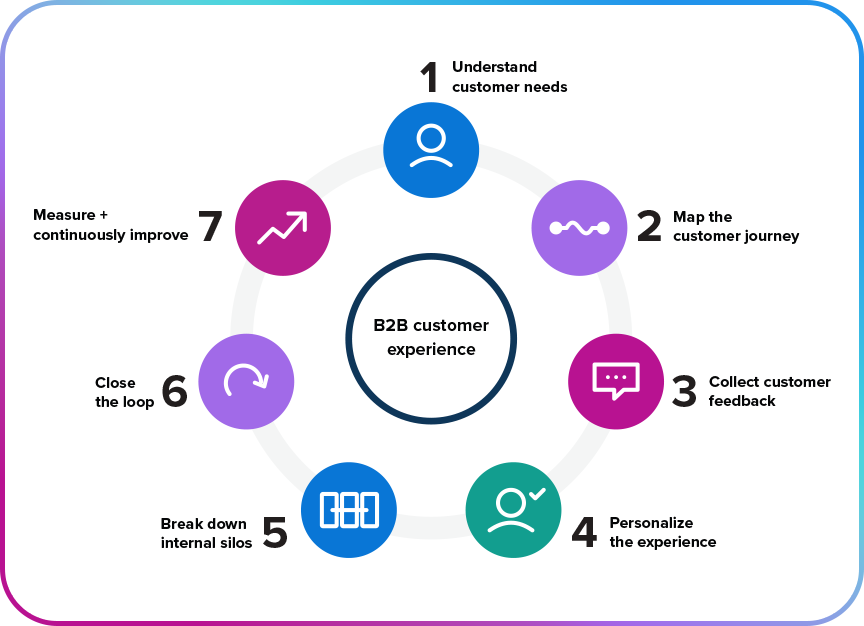
Here are 7 steps you can take to improve B2B CX:
- Understand customer needs and pain points: Use feedback, account conversations, and behavioral signals to see what customers are trying to accomplish and where they struggle.
- Map the B2B customer journey: Document key stages, stakeholders, touchpoints, expectations, and friction across the complete relationship.
- Collect customer feedback: Listen at meaningful points throughout the lifecycle so teams can understand how the experience changes over time.
- Personalize the customer experience: Use account and stakeholder context to make communications, resources, and support more relevant.
- Break down internal silos: Make sure sales, implementation, account management, and support aren't working from different versions of the customer. Shared context helps teams understand what has already happened, what was promised, and what the account needs next.
- Act on feedback and close the loop: Route important feedback to the team that can address it, establish clear ownership, and follow up so customers know their input went somewhere. SMG’s action planning guide offers additional strategies for turning customer insights into meaningful improvements.
- Measure and continuously improve: Track the signals that matter to the relationship, look for recurring patterns, and adjust as customer needs evolve.
Achieve Great B2B Customer Experience with SMG
B2B relationships are built across many interactions, people, and channels. Seeing those experiences together helps teams understand where customers are finding value, where context is getting lost, and what deserves attention next.
SMG helps organizations connect insights across BX, CX, and EX through Unified Experience Management® (UXM), combining connected signals with expert guidance to help teams identify priorities and make more confident decisions.
And that human expertise matters. SMG brings deep experience in experience management, with people working alongside your teams to interpret what the data is saying, understand the context behind it, and determine where to focus. You get technology to bring the signals together and experienced partners to help turn those insights into meaningful improvements.
Ready to strengthen your B2B customer experience? Explore SMG’s customer experience management solutions to see how we help teams build stronger customer relationships, or schedule a demo to talk with our team about what a more connected approach could look like for your organization.