

Published on Jul 10, 2026

Digital is now one of the most important parts of the customer journey.
Customers discover products online, compare prices on mobile, read reviews, visit stores, use loyalty accounts, abandon carts, return later, and expect the whole journey to feel connected. Digital and physical experiences shape each other, and customers rarely separate one from the other.
What is digital experience management, and why does it matter for XM?
Digital experience management is the practice of understanding, measuring, and improving how customers interact with digital touchpoints across the journey, from browsing and checkout to loyalty, support, and repeat purchases.
That matters because digital plays a direct role in conversion, loyalty, and revenue. Digital commerce captures nearly a third of all retail spending, more than 80% of retail consumers use multiple channels in their shopping journey, and 70% of customers have abandoned a cart in the last 12 months.
For brands, the message is clear: digital experience is customer experience.
The challenge is that many teams still struggle to understand where digital friction is happening, why users are dropping off, and what should change next. They may know conversion is low, but they cannot always explain why. They may have customer feedback, but lack visibility into the behavior behind it. They may use multiple digital tools, but still find it difficult to connect digital signals with the broader customer journey.
That is where digital experience management becomes essential.
Why digital experience is central to customer experience
Digital touchpoints do more than support transactions. They shape customer expectations.
A customer visits your site with intent to buy. They browse. They compare. They add an item to their cart. Then something gets in the way.
Maybe the promo code does not work. Maybe shipping fees appear too late. Maybe product information is unclear. Maybe the checkout flow feels too long. Maybe the customer gets distracted and never returns.
From the outside, it may look like a simple abandoned cart. In reality, it may be a missed revenue opportunity hiding inside the experience.
This is one of the biggest challenges with digital CX. Teams can often see that performance is slipping, but they cannot always diagnose what caused it. Conversion rates, cart abandonment, and drop-off points show where something changed. They do not always explain what the customer experienced in the moment.
When digital experience data sits apart from CX data, teams may see only part of the story. That makes it harder to understand what customers are experiencing and harder to decide where to act first. That guesswork slows decision-making and makes it harder to prioritize the changes that will have the greatest impact.
What is digital friction?
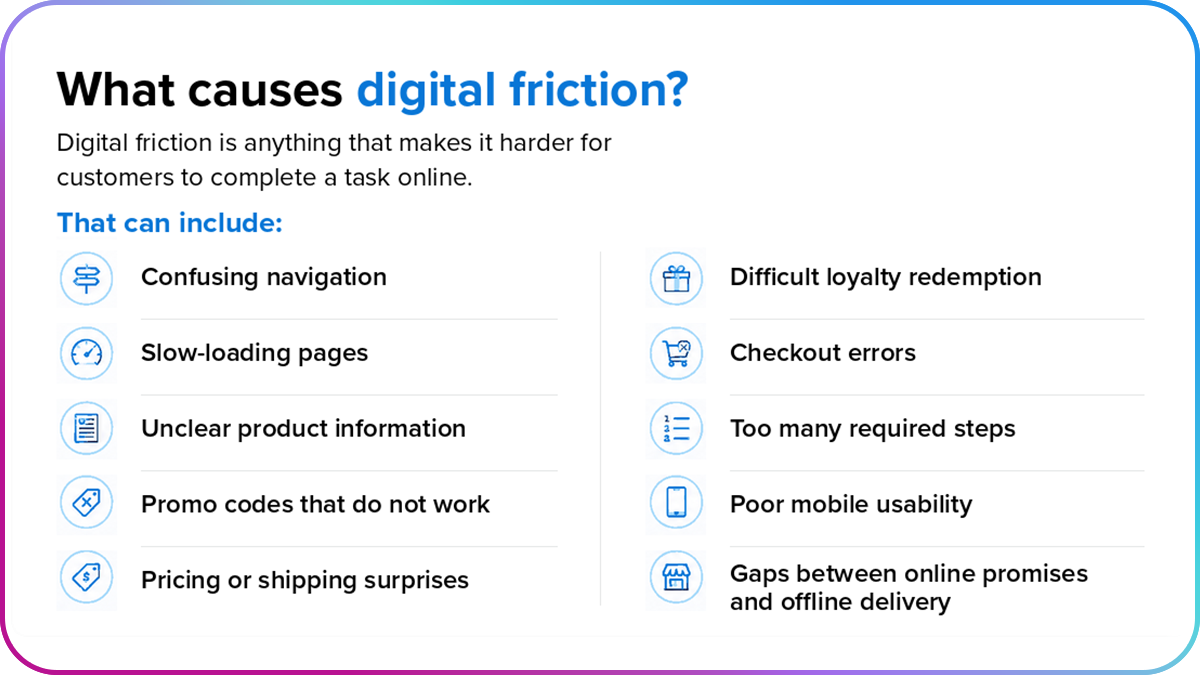
Digital friction is anything that makes it harder for customers to complete a task online.
That can include:
- Confusing navigation
- Slow-loading pages
- Unclear product information
- Promo codes that do not work
- Pricing or shipping surprises
- Difficult loyalty redemption
- Checkout errors
- Too many required steps
- Poor mobile usability
- Gaps between online promises and offline delivery
Digital friction matters because small moments can change customer behavior quickly. A customer may intend to buy, then leave because something feels unclear, difficult, or inconvenient.
Why digital friction is easy to miss and expensive to ignore
Digital feedback is valuable. It helps teams hear directly from customers at key moments in the journey.
Feedback alone can leave gaps.
A customer may say checkout was frustrating, but the team still needs to understand what actually happened. Did the customer struggle with payment? Did they miss a required field? Did the page load slowly? Did they search for a discount code? Did they hesitate when shipping costs appeared?
Behavioral data helps fill in those gaps. It shows how visitors move through journeys, where they pause, where they abandon, and how they interact with the experience.
Why customer feedback and behavioral analytics work better together
Traditional digital metrics may show where the customer dropped off. Customer feedback may show that something felt frustrating. Session behavior may show what the customer did in the moment.
Each signal helps. The real value comes when those signals work together.
- What customers say: feedback captured at key moments in the digital journey
- What customers do: behavior across sessions, journeys, and funnels
- What it means: clear, prioritized insight that helps teams improve the experience
When teams can connect feedback with behavior, digital experience becomes easier to understand and easier to improve.
Why siloed digital tools slow down XM teams
Many organizations already have digital tools in place. They may use analytics, intercept surveys, session replay, CX platforms, journey dashboards, or separate reporting tools.
The issue is that those tools often sit apart from each other.
Digital teams may look at behavior data. CX teams may look at feedback. Operations may look at store performance. Marketing may look at conversion and acquisition. Each team has part of the story, but no one has the full view.
That creates friction inside the business.
Teams spend time pulling reports, reconciling data, and trying to interpret signals manually. Decisions take longer. Priorities get debated. Digital fixes happen without enough customer context, and CX insights stay disconnected from the online behaviors that shaped them.
For XM teams, this is where the digital experience becomes harder to manage. Without a connected view, teams may see the symptom without understanding the cause. They may know a journey is underperforming without knowing whether the issue is usability, expectation-setting, value perception, fulfillment, loyalty, or something happening outside the digital channel.
Digital experience management helps bring those signals together so teams can move from isolated insight to connected action.
And that’s why we build Ignite Digital.
How Ignite Digital helps teams improve digital customer experience
Ignite Digital helps brands improve conversion and loyalty by finding friction in the digital experience and showing teams how to act on it.
It brings together behavioral analytics, customer feedback, and broader experience data so teams can better understand the digital journey and where it connects to the rest of the customer experience.
With Ignite Digital, teams can:
- Capture feedback at key moments in the digital journey
- Understand how visitors move through journeys, funnels, and sessions
- Identify where friction is slowing conversion
- Segment visitors to understand different behaviors and needs
- Connect digital experience insights with broader CX signals
- Prioritize the actions most likely to improve conversion, loyalty, and repeat purchase
The goal is clearer decision-making across the customer journey.
How to turn digital experience insights into action
Digital experience management works best when teams can move from signal to decision quickly.
It helps brands answer questions like:
- Why are customers abandoning carts?
- Where are visitors getting stuck?
- Which digital issues have the biggest impact on conversion?
- How does digital friction affect loyalty and repeat purchase?
- How do digital experiences connect to broader customer sentiment?
- Which improvements should teams prioritize first?
These answers matter because even small improvements in conversion can have meaningful revenue impact. When a brand can identify and reduce the friction causing customers to abandon a purchase, the upside can be significant.
Why digital experience needs a connected XM approach
Digital experiences influence how customers perceive the brand, how likely they are to purchase, how often they return, and how they move between online and offline channels.
That is why Ignite Digital supports SMG’s broader approach to Unified Experience Management®.
By connecting digital behavior, customer feedback, and omnichannel experience signals, Ignite Digital helps teams understand digital performance in the context of the full journey. Teams can see how digital friction connects to customer satisfaction, loyalty, operational performance, and broader experience outcomes.
That is why digital experience needs to be managed as part of XM, rather than as a standalone channel.
That connected view helps reduce silos across CX, digital, marketing, operations, and frontline teams. It gives everyone a clearer understanding of where friction is happening, why it matters, and what should happen next.
Frequently asked questions about digital experience management
What is digital experience management?
Digital experience management is the process of measuring and improving how customers interact with digital touchpoints across the customer journey, including websites, apps, checkout flows, loyalty experiences, and support channels.
Why does digital experience matter in XM?
Digital experience matters in XM because customers move between online and offline touchpoints throughout the journey. Digital friction can affect conversion, loyalty, brand perception, and the overall customer experience.
What is digital friction?
Digital friction is anything that makes it harder for customers to complete a digital task, such as finding a product, using a promotion, completing checkout, redeeming loyalty rewards, or getting support.
How can brands reduce cart abandonment?
Brands can reduce cart abandonment by identifying where customers drop off, understanding why they hesitate or leave, connecting behavioral data with customer feedback, and prioritizing fixes that reduce effort and improve confidence.
Why should customer feedback and behavioral analytics be connected?
Customer feedback helps teams understand what customers say about the experience, while behavioral analytics shows what customers actually do. Connecting both gives teams a clearer view of digital friction and how to fix it.
How does Ignite Digital help improve digital customer experience?
Ignite Digital helps teams connect customer feedback, digital behavior, and broader experience signals so they can identify friction, prioritize improvements, and improve conversion and loyalty across the digital journey.
What is the connection between digital experience management and Unified Experience Management®?
Digital experience management supports Unified Experience Management® by connecting digital touchpoints with the broader customer journey. That helps teams reduce silos, understand experience performance across channels, and act on the issues that matter most.
Ready to find the friction costing you conversion?
The future of XM depends on connecting more than digital data. It depends on connecting what customers say, what they do, and what those signals reveal about the full customer journey.
Connect with SMG to learn how Ignite Digital can help your team improve digital experience, reduce silos, and turn more customer intent into action.

6 ways to reduce digital friction
Learn six practical ways to reduce digital friction, improve conversion, strengthen customer loyalty, and create better digital experiences with customer feedback and behavioral insights.

Convenience store traffic: 3 of the latest consumer trends you need to know
Informed by real-world data, these 3 CX convenience store trends map the customer traffic patterns and expectations to know so stores can drive loyalty in 2023.

How understanding the customer journey elevates customer experience
Discover how understanding and optimizing each phase of the customer journey—from awareness to advocacy—can elevate your customer experience strategy, build loyalty, and drive conversions. Learn actio