

By Matthew McBee, PhD on Nov 24, 2026

Customer loyalty can be difficult to capture in a single number. Every customer brings different expectations and experiences to your brand, and those experiences shape whether they’ll come back, recommend you, or look elsewhere.
Net Promoter Score (NPS) gives you a simple way to understand where customers stand by measuring how likely they are to recommend your company, product, or service. When you connect that score with customer feedback and context, you can identify what’s working, uncover friction, and make more informed decisions about where to improve.
What Is a Net Promoter Score?
Net Promoter Score is a customer loyalty metric that measures how likely customers are to recommend a company, product, or service to a friend or colleague.
Customers answer a standardized recommendation question on a scale from 0 to 10. Their responses place them into 1 of 3 groups: detractors, passives, or promoters. Those groups are then used to calculate an NPS score that can be tracked over time.
How to Calculate Net Promoter Score
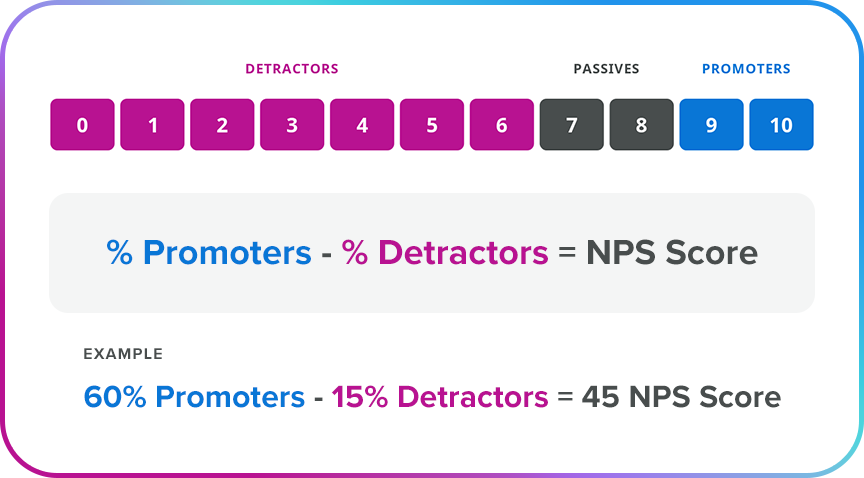
The NPS score calculation starts by grouping respondents according to their 0-to-10 rating:
- Detractors: Customers who respond with a score from 0 to 6
- Passives: Customers who respond with a score of 7 or 8
- Promoters: Customers who respond with a score of 9 or 10
To calculate Net Promoter Score, subtract the percentage of detractors from the percentage of promoters:
Percentage of Promoters − Percentage of Detractors = NPS
Note: Passives are included in the total number of survey responses used to calculate the percentages, but they are not directly included in the final formula.
Net Promoter Score Example
Say you receive 100 responses to an NPS survey. Of those customers, 60 are promoters, 25 are passives, and 15 are detractors.
The calculation is:
60% promoters − 15% detractors = NPS of 45
An NPS calculator can perform the same calculation automatically. Either way, understanding how the score is calculated makes it easier to interpret what changes in NPS may mean over time.
Net Promoter Score Question Examples
Every NPS survey should begin with the standard recommendation question. An open-ended follow-up question can then help you understand what influenced the customer’s rating.
Depending on what you want to measure, Net Promoter Score question examples include:
- Company NPS: How likely are you to recommend our company to a friend or colleague?
- Product NPS: How likely are you to recommend this product to a friend or colleague?
- Service NPS: How likely are you to recommend our service to a friend or colleague?
- Interaction-based NPS: Based on your recent experience, how likely are you to recommend our company to a friend or colleague?
- Follow-up question: What is the primary reason for your score?
- Improvement question: What is one thing we could do to improve your experience?
The rating gives you a consistent metric for the experience you’re measuring. Follow-up and improvement questions help explain why customers responded the way they did, giving you more context to identify what’s working, where there’s friction, and where to take action.
The Benefits of Net Promoter Score
Net Promoter Score gives organizations a simple, consistent way to monitor customer loyalty and identify areas that may require further investigation. Because the metric is easy to understand, it can also create a common point of reference across teams and leadership.
The benefits of Net Promoter Score include:
- Providing a simple customer loyalty metric
- Making it easier to track changes over time
- Identifying promoters and at-risk customers
- Highlighting customer experience issues
- Supporting customer segmentation
- Creating a common CX metric for leadership
The key is knowing what NPS can and cannot do. It can show you where customer sentiment stands. Connecting that score with customer feedback and operational context can help you decide what to do next.
What Is a Good NPS Score?
A good NPS score depends on your industry, audience, survey method, and historical performance.
NPS can range from -100 to 100. A positive score means you have more promoters than detractors, but there isn’t one number that defines success for every organization.
As a general guide:
- Below 0: Suggests there are more detractors than promoters
- 0 to 30: Generally positive
- 30 to 70: Generally strong
- Above 70: Considered exceptional
Context matters when interpreting these ranges. Rather than looking at a single score in isolation, consider how your NPS changes over time and across relevant customer groups, journeys, or locations. That can give you a clearer picture of where customer sentiment is improving and where further investigation may be needed.
For further reading: Metrics that matter: Is NPS still relevant today?
Net Promoter Score Benchmarks
NPS benchmarks help you understand how your results compare with relevant industry performance and your own historical results.
For those comparisons to be meaningful, consistency is key. Survey timing, audience, and collection methods should remain consistent whenever possible. Otherwise, a change in methodology could make it difficult to tell whether movement in the score reflects an actual change in customer experience.
External benchmarks can provide perspective. Your own trends can help you understand whether the experiences you deliver are moving in the right direction.
Types of Net Promoter Score Surveys
You can use NPS at different points in the customer relationship depending on the question you’re trying to answer.
Relational NPS
Relational NPS measures a customer’s overall relationship with your organization. It is typically collected at regular intervals, helping you monitor broader changes in customer loyalty over time.
Transactional NPS
Transactional NPS is collected after a specific interaction, such as a purchase, service visit, support case, or onboarding experience.
Because the survey is connected to a particular moment, it can help you understand sentiment around specific parts of the customer journey and identify experiences that may deserve a closer look.
Employee Net Promoter Score
Employee Net Promoter Score, also known as eNPS, is a related metric that measures how likely employees are to recommend their organization as a place to work.
eNPS follows the same basic calculation as customer NPS: responses are grouped into promoters, passives, and detractors, and the percentage of detractors is subtracted from the percentage of promoters. The difference is what you’re measuring: Customer NPS focuses on customer loyalty, while eNPS focuses on the employee experience.
How to Improve Net Promoter Score
Improving Net Promoter Score starts with addressing the customer experiences behind it, not simply trying to make the number go up. Use NPS alongside customer feedback to identify recurring friction, understand what customers value, and prioritize meaningful improvements.
Ways to improve a Net Promoter Score include:
- Follow up with detractors to understand their concerns
- Ask promoters what your organization does well
- Identify recurring themes in open-ended feedback
- Prioritize pain points with the greatest customer impact
- Assign ownership to customer experience improvements
- Close the feedback loop with individual customers
- Communicate broader changes made from customer feedback
- Compare results across journeys, locations, and customer segments
- Track whether improvements affect NPS and other business outcomes
The goal is to turn insights into action. Understanding what is influencing your score can help you focus resources on the improvements that matter most to customers.
Turn NPS Insights Into Meaningful Action
Net Promoter Score gives you an important measure of customer loyalty, but the real value comes from what you do with what you learn. Connecting NPS with other experience signals can help you understand what’s driving customer sentiment, identify opportunities for improvement, and make more confident decisions about what comes next.
That’s where a more unified approach to experience management can make a difference. SMG helps organizations connect brand, customer, and employee experience insights to build a clearer picture of what’s happening across the business. Through Unified Experience Management® (UXM), you can bring experience signals together with the context needed to turn insights into meaningful action.
Ready to put your NPS insights to work? Explore our customer experience management solutions, connect with our team, or schedule a demo to see how SMG can help strengthen your experience strategy.