

Published on Apr 30, 2026

Most organizations have invested heavily in AI for experience management. There’s more data, more dashboards, and more visibility than ever before.
And that investment is only accelerating. In fact, 70% of organizations are actively investing in technologies that automatically capture and analyze intent signals, while 70% of CX leaders say generative AI has already pushed them to re-evaluate their customer experiences. On the customer side, expectations are shifting just as quickly—59% of consumers believe generative AI will change how they interact with companies in the next two years.
And yet, many teams still feel like they’re moving too slowly.
It’s not because the insights aren’t there. It’s because turning those insights into action still takes time. Teams review performance, identify trends, and align on next steps—but by the time action happens, the moment has already passed.
This is the gap many organizations are facing. It looks like progress, but it doesn’t always lead to better outcomes.
Which raises a bigger question: is doubling down on legacy AI really the answer?
The problem with legacy AI in customer experience (CX) and XM
AI was meant to simplify decision-making. In many cases, it has added another layer between insight and action.
Most legacy AI systems in XM are built to analyze and report. They surface patterns, generate summaries, and help teams understand what’s happening. But they still rely on people to interpret that information and decide what to do next.
This creates friction in a few key ways:
- Disconnected signals: Customer feedback, employee input, and operational data live in separate systems
- Unclear prioritization: Teams see multiple issues but lack clarity on what matters most
- Delayed action: Insights are visible, but not embedded into workflows
This creates a false sense of confidence. Teams believe they’re data-driven, but in reality they’re still reacting after the fact (just with better reporting).
What are agentic insights in experience management?
Agentic insights are a new approach to AI in experience management that are designed to close the gap between insight and action.
“Agentic” refers to AI that can do more than generate information. It can reason through signals, make recommendations, and help initiate the next best step based on a defined goal.
Instead of simply reporting what happened, they help guide what should happen next. They interpret signals, prioritize what matters, and surface recommended actions in real time.
For example, a restaurant brand using agentic AI can detect a drop in satisfaction at a specific location, identify staffing or service issues, and trigger recommended actions for managers—all in real time.
Legacy AI vs. Agentic AI
Here’s the difference in practice:
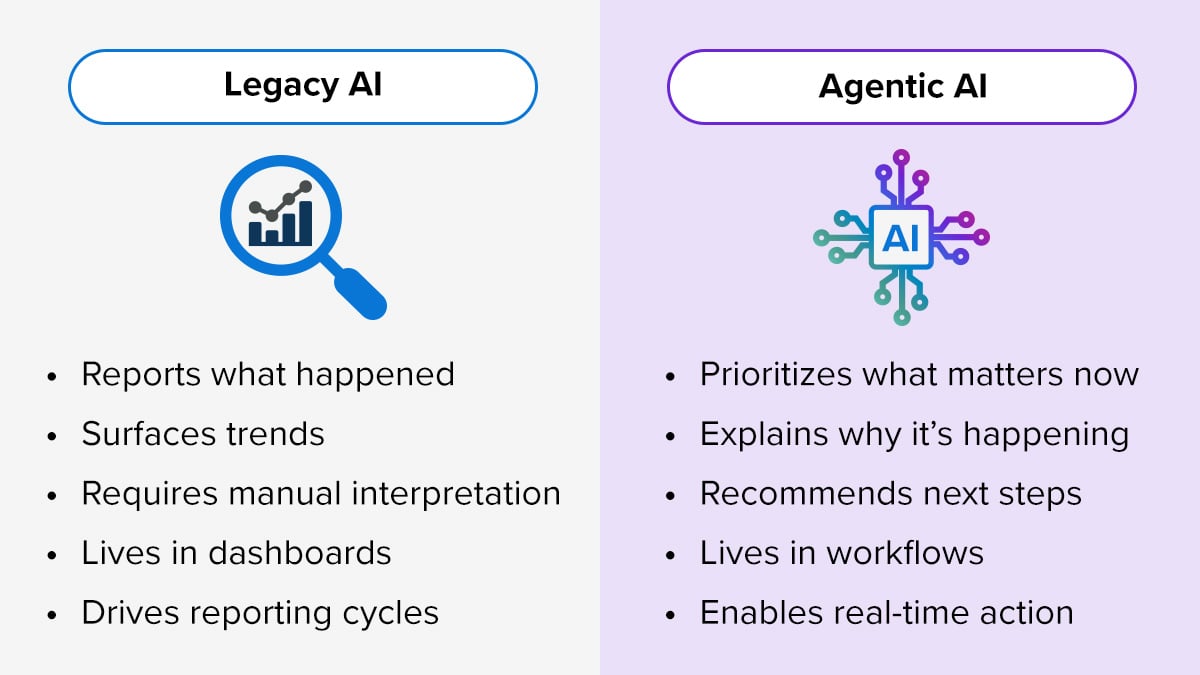
This shift changes how organizations operate.
The real challenge: Decision velocity in experience management
Most organizations don’t struggle with access to data. The real difference between leading and lagging brands is how quickly they turn insight into action. When decisions stall, opportunities are missed and the customer experience suffers.
That’s especially true in experience management, where customer experience, employee experience, and operational performance are deeply connected. A staffing issue can quickly become a service issue. A service issue can affect satisfaction, loyalty, and revenue.
Legacy AI systems often create blind spots because they were built to analyze and report, not to connect signals across the business and guide timely response. By the time issues are fully understood and teams align on what to do next, customers have already felt the impact.
Agentic insights solve for this by reducing the time between detection, decision, and execution. They help organizations move from understanding what happened to acting on what needs to happen next.
What agentic insights look like in practice
In a traditional model, a drop in customer satisfaction might appear in a monthly report. Teams review the data, investigate causes, and plan next steps.
With agentic AI, that same issue is identified as it emerges. The system connects it to operational drivers, flags it to the right team, and suggests immediate actions.
The difference is not just speed. It’s relevance.
Benefits of agentic insights for customer experience teams
Agentic insights change the way teams operate.
Instead of searching for issues, teams are guided toward what matters most. Instead of debating priorities, they have clearer direction. And instead of waiting for reporting cycles, they can act in real time.
This shift is already underway. Twenty-three percent of organizations report they are actively scaling agentic AI systems within their enterprise, signaling a move from experimentation to real operational change.
For those making that transition, the impact is clear:
- Faster prioritization of high-impact issues
- Shorter time to action between insight and response
- Connected signals across CX, EX, and operations
- More consistent execution across locations and teams
Experience management becomes proactive instead of reactive.
How AI-native experience management platforms enable agentic insights
To make this shift possible, the underlying technology needs to change.
AI-native experience management platforms are built with AI at the core, not layered on after the fact. They continuously interpret signals, connect data across sources, and integrate directly into workflows.
This allows organizations to:
- Connect customer, employee, and operational insight
- Surface the most important signals automatically
- Guide actions within existing workflows
- Reduce reliance on manual interpretation
Instead of treating insight as something to review, these platforms treat it as something to act on.
How Ignite® enables agentic insights in experience management
This is where platforms like Ignite® come in.
Ignite® is an AI-native experience management platform that connects customer, employee, and operational signals into a single, actionable view. It helps teams understand what’s happening, why it’s happening, and what to do next—without requiring manual interpretation at every step.
By embedding insight directly into workflows, Ignite enables teams to move faster from insight to action and make more confident decisions.
Because in today’s environment, insight alone isn’t enough. What matters is how quickly you can act on it.
If you’re ready to move beyond legacy AI and start turning insight into action, connect with SMG to see how AI-native experience management can help you close the gap.

Why emotional intelligence is the missing link in customer journey mapping
Discover how emotional intelligence, journey mapping, and buying triggers work together to create customer experiences that feel more human.

From barriers to breakthroughs: How to turn CX insights into real impact
Explore common barriers that prevent CX insights from driving action and learn how brands can turn customer feedback into measurable business improvements.

Annual hackathon helps drive SMG’s mission of innovation by inspiring products + technologies that create meaningful change
SMG’s hackathon is an opportunity for our technology team to think big, collaborate in a fun and unique way, and bring innovative ideas to fruition. Today we sat down with Chief Information Office Mar