

Published on May 26, 2026

If your team is asking customers for feedback but still struggling to act with confidence, the problem may not be volume. It may be a tool fit.
Most experience management teams aren’t short on feedback. They’re collecting it across surveys, trackers, brand studies, and ad hoc research. But this input isn’t always available in the right form, context, or moment to support the decision in front of them.
Forrester says U.S. customer experience quality is at an all-time low, and only 3% of companies are currently customer-obsessed. In other words, many brands are collecting feedback, but far fewer are turning it into experience improvements customers can actually feel.
That’s where the distinction between customer surveys and customer communities matters.
What is the difference between customer surveys and customer communities?
Both are valuable parts of a customer feedback strategy, but they serve different purposes. Customer surveys are structured tools used to collect feedback at scale, typically through ratings, scores, and standardized questions. Customer communities are ongoing groups of engaged participants who provide deep insight through dialogue, exploration, and continuous feedback. Together, they support both measurement and understanding.
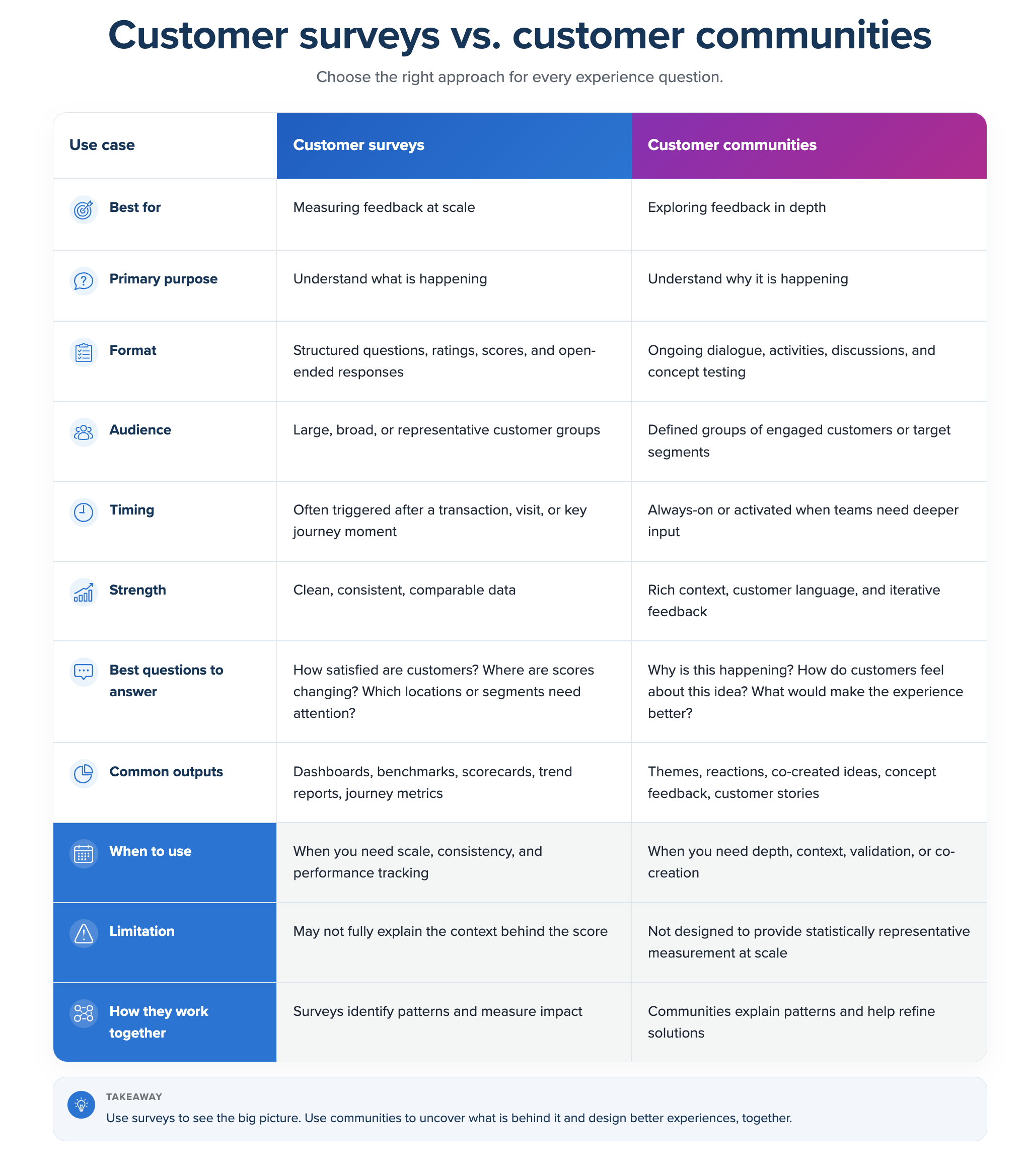
The mistake XM teams make is not choosing one method over the other. It is using the wrong method for the decision they need to make.
Why XM teams often confuse communities and surveys
The issue comes up when teams expect one method to do the other’s job. If a survey shows satisfaction dropping in a region, a community can help explain the story behind the score before teams decide what to change. If a community helps refine a new concept, a survey can measure how that concept performs across a broader audience.
The better question is which method fits the decision in front of you.
What surveys do best
Surveys shine when you need to capture feedback from a broad audience, benchmark performance over time, or quantify trends across locations, channels, or segments. They're the backbone of most structured XM programs for good reason: they generate consistent, comparable data that can drive scorecards, inform dashboards, and track whether things are getting better or worse.
Note: That is a useful reminder that volume does not equal validity. More responses are not automatically better if they do not come from the right audience or support the decision you are trying to make.
Done well, surveys help you spot patterns you'd never catch manually, whether that’s a dip in loyalty scores in a specific region, a friction point that's appearing consistently across a particular journey stage, or a satisfaction gap between customer segments.
Use surveys when you need clear, comparable data
Customer surveys are the right tool when the goal is measurement. Reach for them when you need:
- Post-visit or post-purchase feedback captured close to the experience
- Relationship or brand tracking over time
- Operational scorecards and performance benchmarking
- Journey measurement across many touchpoints and locations
A few pro tips for getting surveys right:
- Keep them short and focused on what you'll actually act on
- Trigger them as close to the experience as possible—context fades fast
- Make sure responses are representative, not just abundant. Volume doesn't equal validity
The goal of a well-designed survey isn't data for its own sake. It's data that's clean, representative, and specific enough to drive a decision.
What communities do best
If surveys are built for measurement, customer communities are built for understanding. And that distinction matters more than most teams realize.
Communities are best for ongoing dialogue and deeper context
A customer community is a defined group of participants—typically people with a genuine connection to your brand—who engage with you on an ongoing basis. Rather than a one-time survey event, a community creates a persistent space for conversation, exploration, and collaboration.
Customers increasingly expect brands to listen, and not just at the end of a transaction. Fifty-seven percent of consumers actively engage with brands through online commenting or direct outreach, and 93% believe brands should react to public opinion. At the same time, only about 1 in 2 consumers say it is easy to contact brands.
That gap helps explain why communities can be so valuable. They create a more intentional, always-on channel for dialogue when customers want to be heard and brands need deeper context.
Communities unlock capabilities surveys simply can't. You can explore the "why" behind a signal you've already measured. You can validate an assumption before you scale it. You can test messaging, concepts, or prototypes with real customers before committing to a launch. And because you're engaging the same participants repeatedly, you build context over time—each conversation building on the last.
Use communities when the decision is still taking shape
Always-on feedback through a community is the right method for feedback when you need depth. Reach for it when you need to:
- Understand what's driving a pattern your surveys have already surfaced
- Test new messaging, positioning, or concepts before launch
- Pressure-test a prototype or service change with real customers
- Explore friction in a specific journey before investing in a fix
- Move faster than a traditional research cycle allows
A few pro tips for getting communities right:
- Start with a specific decision, not a vague desire for more feedback
- Segment your community so you're hearing from the right people for the right questions
- Close the loop—let participants know where their input went and what it shaped. That transparency is what keeps people engaged long-term
For a deeper look at how to build a community that actually works, check out [A practical playbook for using communities to design better customer experiences].
When surveys are the better choice
If you need a quick gut-check, here's the short version.
Choose a survey when you need to:
- Measure performance consistently over time
- Compare results across locations, segments, or channels
- Gather broad feedback from a large and varied audience
- Quantify satisfaction, loyalty, or sentiment
- Feed dashboards, scorecards, and benchmarking reports
If you need scale, consistency, and comparability, a survey is usually the stronger fit.
To learn more about designing surveys that generate strong, actionable data, take a look at [Elevating your XM program: Three key areas to focus on].
When communities are the better choice
Choose a community when you need to:
- Explore why a pattern is happening, not just confirm that it is
- Test ideas before investing heavily in execution
- Refine concepts, messaging, or journeys through real customer input
- Gather feedback from the same audience over time as decisions evolve
- Move faster than a traditional research cycle allows
If the goal is exploration, iteration, or co-creation, communities are usually the stronger fit.
When the best answer is both
Here's where the conversation gets more interesting—and more useful.
Surveys and communities aren't competing tools. They're complementary ones. Surveys tell you what's happening at scale. Communities help explain why. Surveys identify a problem. Communities help teams test and refine the fix before rolling it out widely.
Together, they create a more complete feedback system—one that moves from measurement to understanding to action, rather than stopping at the data layer.
A practical example of how to choose the right feedback method:
- Use surveys to detect friction in your onboarding experience
- Use a community to understand what's actually driving that friction
- Test revised messaging or workflow ideas within the community before committing to a rollout
- Use surveys again to measure whether the fix worked at scale
That’s not two separate programs running in parallel. That’s one connected customer feedback strategy, where each method does what it’s best at and hands off to the other when the job changes. That’s why Unified Experience Management® (UXM) works well: it brings feedback signals into one connected view so teams can move from isolated insights to a clearer understanding of the customer experience.
For more on connecting insight to action across your XM program, see [Which XM tools support real-time experience management?]
What this means for experience management in 2026
The XM programs flourishing in 2026 aren't the ones with the most feedback. They're the ones with feedback that's fit for purpose: structured measurement where scale matters, always-on feedback where depth matters, and a clear path from insight to action across both.
Co-creation is a competitive advantage if you build it right
SMG works with brands to build feedback strategies that fit the decisions they're actually trying to make, beyond the data they're already collecting.
That means supporting structured survey programs designed for clean, representative, actionable data. And it means helping teams stand up customer insight communities, through Ignite Communities, that create the always-on dialogue needed to explore, validate, and move faster than traditional research allows.
The goal is connected feedback that flows to the right people, in the right form, at the right moment. With Ignite®, community and survey insights can come together in one UXM strategy, helping teams reduce silos, act with more confidence, and ensure every decision is backed by something more than guesswork.
If you’re not sure whether your team needs surveys, communities, or a more connected feedback strategy, let’s talk through the right approach for the decisions you're trying to make.

Community Engagement: What It Is, Why It’s Important & Examples
Learn what community engagement is, why it matters, and how to build, measure, and strengthen a community that drives better customer experiences.

The economic impact of a customer experience management program on your business: How to potentially develop 550% ROI in 3 years or less
An experience management (XM) program can drive changes across your business that increase loyalty, reduce churn, and generate revenue—and even the

Why consumers join, stay, and leave: A closer look at membership behavior
Dive into new data from SMG on why members join and cancel, what gets them to stay, and how you can design more valuable experiences at every stage.